Alert Fatigue

In the medical quality improvement literature literature, there is acknowledgement of a phenomenon called “Alert Fatigue.” 

I’ll give you the wikipedia definition:  Alarm fatigue or alert fatigue occurs when one is exposed to a large number of frequent alarms (alerts) and consequently becomes desensitized to them. Desensitization can lead to longer response times or missing important alarms.

I believe my life is currently a series of alert fatigue for different kinds of alarms/alerts.  And today, dear readers, I am going to rant about alert fatigue with text messages.  

To get started, I will out myself as the Xennial/Oregon Trail Generation member that I am.  I’m in that awkward group that is too young to be Gen X and too old to be a millennial.  We are a microgeneration defined by growing up as technology grew up.  One of the coolest days in my childhood was when I got this phone:  

Swatch Twin Phone–two people could talk at once, y’all!

And the most fun thing I did in elementary school was play the original, green screen version of The Oregon Trail.  Our teachers were fairly convinced the new “computer lab” was just a fad.  
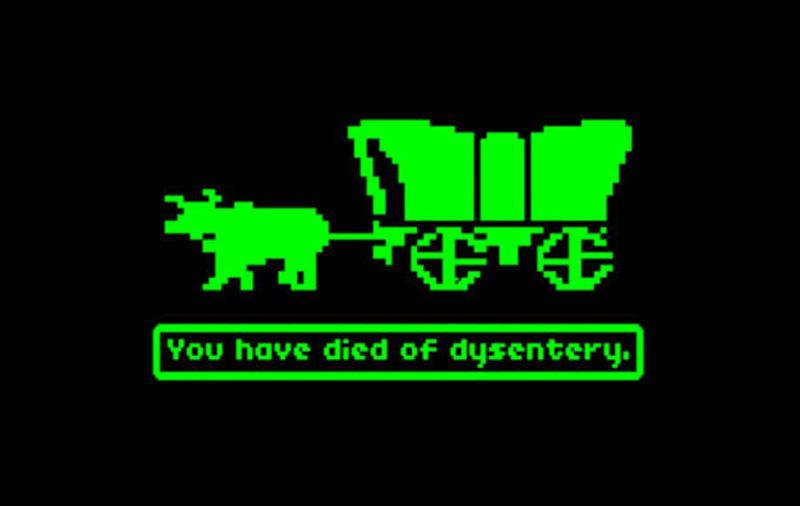
Facebook didn’t come out until the year after I graduated from college.  The iPhone didn’t come out until I was in my clerkship year of med school.  

Because I grew up with the evolution of communications technology, I feel like I’ve also grown up with the evolution of spam.  

1st it was by snail mail.  And people slowly stopped using snail mail socially.

2nd it was by telephone.  And people slowly stopped calling on the phone socially.

3rd it was by email.  And people slowly stopped writing emails socially.

Now it is by text. 

Video-chatting seems to be the next wave of communication.  Will that be the next wave of spam too?  

I get multiple spam texts a day.  It was worse during the election season.  At any given time I have unread texts in the double digits on my phone.  I used to love texts.  I’m a self-admitted introvert.  Picking up the phone to talk to someone (even just to order a pizza) still gives me palpitations.  I once thought texts were awesome.  Let me tell you know why I now HATE THEM.  

  1.  People try to communicate ideas that are too complex via text.  If we have to exchange more than 1-2 texts to get an idea across it should be an email (if non-urgent) or a phone call (if urgent).  
  2. People expect immediate responses from text messages.  This used to be acceptable when you got 1-5 texts a day total.  But my phone is dinging multiple times an hour.  Some texts are important.  Others are the Japanese restaurant I ordered from once in Pittsburgh telling me they are having a special.   Due to alert fatigue, I now pretty much ignore them all.  
  3. People text you to try and arrange a time for a phone call?  WTF is this about?  If it isn’t arranging a group call (aka herding cats), you both already have your phones in your hand.  Just dial the number and speak.  If the person can’t talk they won’t answer and they will call you back.  (This has to be a product of the Xennial in my who is still delighted by my old swatch twin phone and answering machines).  

I can’t remember the last time someone called me to talk about anything non-work related.  The only non-work phone calls I get now are appointment reminders and obvious spam (so I don’t even pick up the phone).  But when a real person calls me (like once every 6 months), I pay much more attention to it than to a text, email, or social media message.  I’m generally convinced when someone calls me socially and unexpectedly, they are calling because someone died.  Unannounced phone calls seem to have been elevated to that level of importance communication wise.  

Am I just a jaded, stressed out, introverted, aging Xennial?  Or are other people as fatigued by all of the unimportant “alerts” via text message/smart phone in their life too?  Maybe not…a lot of people now strap the things to their arms in the form of smart watches.  

Do we really need to be this connected, people?

Pretty Good with a Bow Staff

A few weeks ago, I got to live the dream.  I was invited by a fellow geriatrician to a screening of one of my favorite movies ever.  We even got to meet the cast!

Pedro, Fellow Geriatrician, Napoleon, Me, Deb

That’s right–we saw Napoleon Dynamite!  

Besides being a hysterical movie, Napoleon Dynamite has some cool lessons about aging.  I will enlighten you on 3 of those lessons here.  

What?  How am I going to turn a discussion about Napoleon Dynamite into a geriatrics post?  WATCH ME!

I’m going to assume many of you have seen the movie–but for those of you who haven’t here is a quick run down.  

Napoleon Dynamite is in high school in a small town in Idaho.  He lives with his 32 year old brother named Kip and his grandmother.  He is insanely and endearingly awkward.  He makes friends with the new kid at school–Pedro, and has a crush on an awkward girl–Deb, who tries to sell him boondoggle keychains while raising money for college.  His grandmother suffers an injury, and asks her son, “Uncle Rico” to come and look after Napoleon and Kip. Uncle Rico is obsessed with “the ’82,” and trying to take State in Football.  Kip is an internet geek, who meets and falls in love with LaFawnDuh online–eventually marrying her.  Napoleon, Pedro, and Deb become friends while Pedro runs for school president.  Napoleon draws ligers, is pretty good with a bowstaff, and dances Pedro into the presidency.  There is more to it–or not really.  If you haven’t seen it, you need to.   

Geriatrics lesson #1 from Napoleon Dynamite:  Older people still have lives.  Those lives may surprise you.  Napoleon’s grandmother goes 4-wheeling in the sand dunes with her boyfriend, and injures herself.  Just because someone is older–don’t count them out for anything.  

Geriatrics lesson #2 from Napoleon Dynamite:  Caregivers generally fall into that role because nobody else will do it.  Uncle Rico doesn’t have to care for the injured older adult.  He has to care for a 32 year old man-boy, and a high-school kid.  He is not happy to be in the role, but steps up anyway.

Geriatrics lesson #3 from Napoleon Dynamite:  Caregivers may not be any more competent or cognitively intact than the person they are caring for.  Again–see Uncle Rico.  He is so obsessed with “the ’82” he has Kip buy him a time machine online.  He truly believes it will work, but the only thing the time machine does is electrocute his private parts.  Napoleon finds it and does the same.  He gets Kip into a pyramid scheme, and knocks Napoleon off his bike with a steak.  

Here’s an extra one for you

Geriatrics lesson #4 from Napoleon Dynamite:  DANCE!!!

Original Dance from Napoleon Dynamite
14 Years Later…

Reminds me of another famous dancer…

Keep moving and dancing, y’all!  Until next time from your favorite Fat Geriatrician!  

I Heart Underdogs


Now that I have published my blog, I have been approached by several people saying, “Why Fat Geriatrician?  You aren’t Fat.”  First of all, thank you for reading the blog!  Second of all, thank you for your kindness–but I’ve got a BMI of 37.8.  Objectively and according to the WHO, I am “Severely Obese.”

So, here is my attempt at explaining why the name Fat Geriatrician appealed to me.

Fat and Old are dirty words in our culture.  We can still make fun of people who are fat and people who are old without really getting called out on it.  People assume that someone who is fat is also lazy, unhygienic, and dumb.  People assume that someone who is older is slow, feeble, and forgetful.

I see both groups as underdogs.  People fighting to be seen as who they are and not the label that society puts on them.  And boy let me tell you:

i_love_underdogs_keychain-r69b4d272432d436ba63dc67871cef88e_x7j3z_8byvr_307

In the past few years I have come to own and embrace my size.  I don’t care about it in a vain way.  Once I embraced shopping in plus sized stores, I started jazzing up my look.  I added dresses, bright colors, and makeup.  I have never felt more fabulous or self-confident.

The only thing that worries me about my size is possible health consequences and early functional losses due to being overweight–hence starting an exercise program (see my first post).

But many people who are fat are not able to embrace their size or practice self-love.  Being obese is often complexly intertwined with other psycho-social issues.

The healthcare system can be especially judgmental (beyond health concerns) of fat people.  We are (unfortunately) becoming a majority of patients.  Medical school teaches cultural competency and has made judging certain diseases taboo (ex. HIV, alcoholism, depression).  However, doctors can still openly judge and shame obese patients–and call it counseling.

I’m constantly getting the side-eye from other doctors (who don’t know me well) about my weight.  I was shamed by attendings for my weight during my training.  I’ve heard physicians and surgeons make snide comments about the weight of patients.  And believe it or not, I was interviewing a trainee for a spot in one of our university’s training programs and this person had the nerve to give the bodycheck/eyeroll/snide remark trio to me about my weight.  If this person did that in an interview, imagine what they would do to a vulnerable patient?

Despite popular opinion fat people are not dumb.  We are actually highly attuned to this kind of behavior (I can say this as a member of the fat tribe).

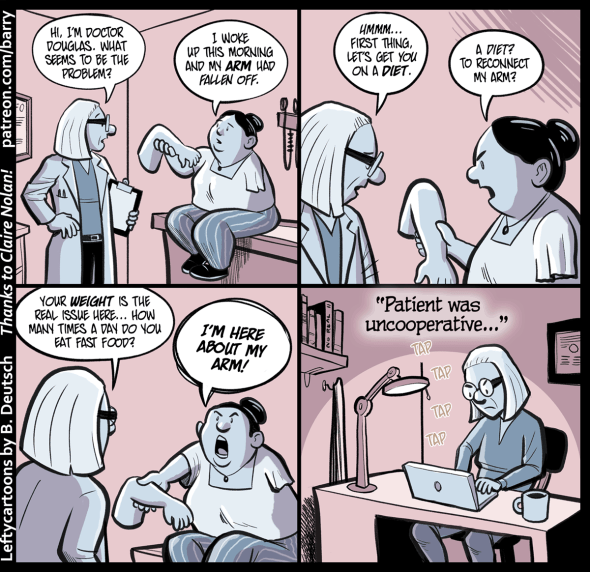
There is research on weight discrimination in healthcare.  It has been found that more than half of doctors describe their overweight patients as ugly, awkward, and noncompliant with treatment.  Nearly one quarter of nurses admitted to feeling repulsed by their obese patients.  Patients pick up on this and do not come back. My working hypothesis about “noncompliance” in many obese patients is that it has more to do with a poor doctor/patient alliance than anything intrinsic to the patient. 

patient was uncooperative

Hopefully I have convinced you that fat people are underdogs, especially in medicine.  Now let me convince you about old people.

One of the things I love the most about being a geriatrician is I get to work with a patient population who is not used to being seen or valued.  They are under-served, but not even on the healthcare system’s radar as being under-served because “50% of Hospital Length of Stay Days are for people age 65+.”  Access and appropriate care are not the same thing.

Anti-Ageism Rant:

Ageism is one of the only acceptable “-isms” left in America, and it is alive and well in the healthcare world.

I can’t tell you how many physicians have told me that they are experts in taking care of older adults (despite no training in aging) because they do it all the time?  The problem is they don’t do it well, and they don’t know it can be done better.  Older adults can also be ageist against themselves in a healthcare system–insisting that their symptoms are due to age.  They also rarely want to admit that they are older adults and that they could benefit from the expertise of someone in geriatrics.   We have a branding problem in our field.

One of my geriatric idols/attendings used to say “Older adults are the canaries in the coal mine for healthcare.”  He was so right.  As we age we become more vulnerable, and our fractured healthcare system that has been set-up for middle aged adults can be downright dangerous for older adults.  When something can go wrong in healthcare, it will go wrong for our older adult patients first.

canario

So I have embraced a career of taking care of these underdogs and their caregivers.  It is more fulfilling than you could ever imagine to see someone who has been told, “oh you are just wetting yourself/forgetful/falling/etc because you are old,” and then making them dry/think clearly/stop falling by practicing good geriatric medicine.  It is life changing for the patient, and brings me so much joy as a doctor.

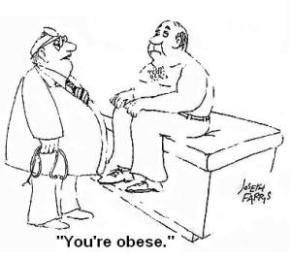
I also love geriatrics because we fear weight loss.  It is a harbinger of functional loss and declining health.  So I got to stop having the uncomfortable you need to lose weight discussions with patients who weighed less than I did.  Instead I get to give the “you can ditch your low salt, low carb, low fat diet–just please eat,” talks!  They are much easier for me as a fat doctor.

youre obese

I think that being a fat “underdog,” and experiencing hidden prejudice in the healthcare system myself is a big part of what drew me to the field of geriatrics.  And therefore, it seemed very fitting to put these two ideas together in the name of my blog.

So there you have it!  Fat Geriatrician for the Win!


Mr. Fat Geriatrician

My husband just read the blog for the first time.  His feedback:  “Sounds like you are a single mom.  Why didn’t you mention me?”

So, this post is all about Mr. Fat Geriatrician.

For starters–he isn’t fat and he isn’t a geriatrician (or any other kind of doctor).  We’ve been married for 5 years, and he is my favorite person in the entire world.

He is a big part of the reason that I could add the “happier” to my tagline.  He has taught me so much about enjoying life.

He has never met a stranger, and his endearing and quirky style causes people to remember him wherever he goes.  He doesn’t take himself seriously (or rather takes himself just seriously enough), and he proudly expresses that to the world by wearing Hawaiian shirts almost every day.

hawaiian supermanHe is not only a fabulous partner, but also a wonderful dad.  We really are 50/50 in this parenting thing.  Watching him toss the kids in the air, make them giggle with delight, and tenderly tuck them into bed makes my heart full.
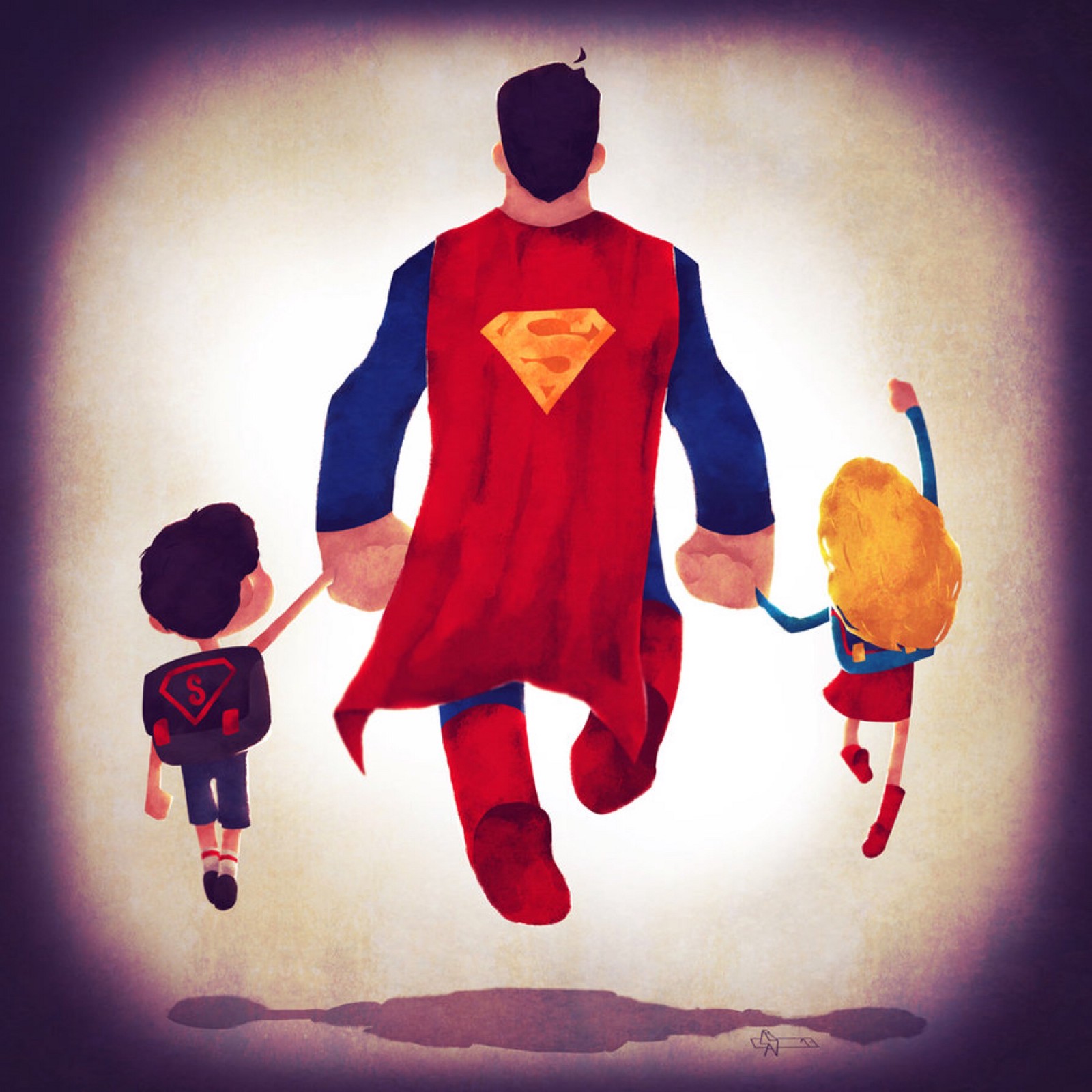
Super Dad

He is 100% supportive of my career, and I could not do what I do without his love and support at home.  He truly is a Super Husband, Super Dad, and Super Man.

I love you, Mr. Fat Geriatrician!

(There, you got your shout-out post, honey!)

First blog post

Hello World!

Welcome to Fat Geriatrician.

I am your host, The Fat Geriatrician.

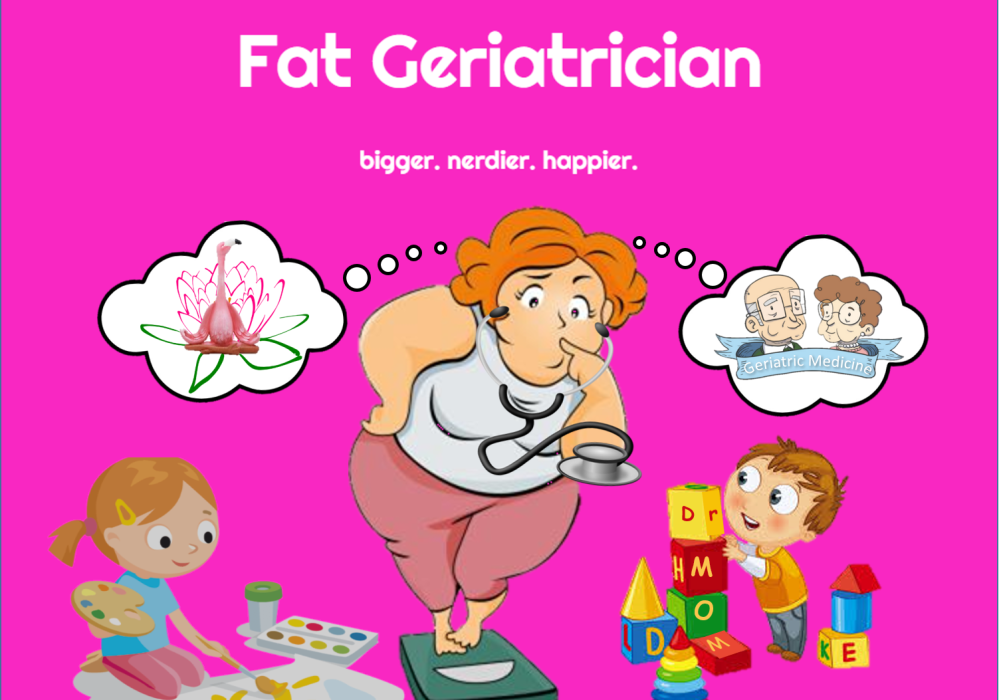
Why start a blog?  Why call myself Fat Geriatrician?  Why in the heck am I thinking about a flamingo meditating on a lotus in the picture above?  I’ll try to tackle the first 2 questions in this post.

To answer those 2 questions, I’ll need to fill you in about a little group on Facebook called Physician Moms Group (PMG for short).  This is a group of over 70k moms who are also doctors (MDs/DOs).  In addition to being bad-asses and generally killing it at life (hahaha), we post about all kinds of things related to the Dr. Mom Life.  (We mostly post about how we don’t feel like bad-asses, and how we are are sucking at the Dr. Mom Life).  For the past 2 months Facebook has labeled me a conversation starter in the group.

Screenshot-2018-08-17-at-4.00.47-PM

I don’t know if I should be proud or horrified at all of the wasted time that represents.

Any-who, I recently made an anonymous post on the group (yeah, it didn’t even count towards my conversation starter status), and I got tons of responses.  One person (a conversation starter in her own right) even commented,

“All I know is that I am so darn proud of you! Also, I had a really hard day and you made me laugh so thank you! Maybe start a blog about your journey! You are a great writer!”

The then she quickly followed it up with,

“And to be clear I am not laughing at you… just you casually describing hanging off a bike in the dark as “a weird experience” and “I may have broken my vagina.””

Her comments were the inspiration for me to start this blog.  Instead of wasting my time with random (usually too long) posts on Facebook, why not collect everything in one place?

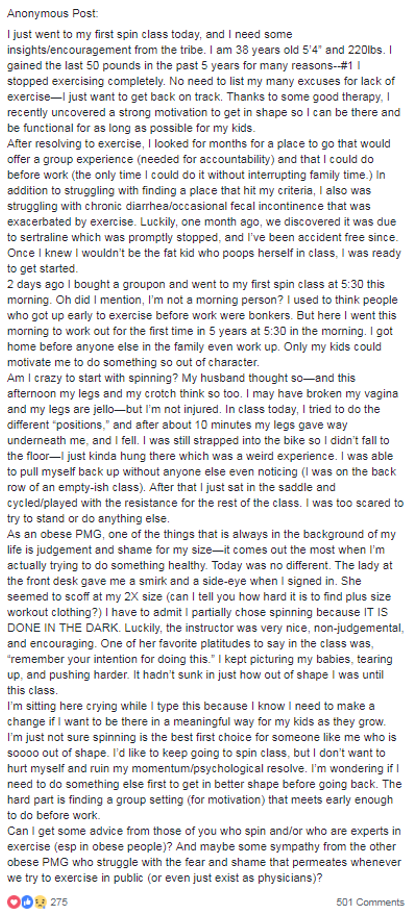
I bet you are wondering what could I have written about that made her respond like that?  Why did a total stranger tell me to start blogging?  I guess I’ll open myself up and claim that anonymous post here:

anonymous post

FYI–I did go spinning again after that post.  It took me 5 full days to recover enough that I could bend my legs again.  On the 6th day I went back on the bike.

Hopefully you are starting to see where the Fat came from in my name.  As a part of this blog, I will intermittently write about the struggles and humorous situations I find myself in because of my size.

In addition to defining myself (and being defined) by my size, I also define myself through my profession, Geriatric Medicine.  Hence the Geriatrician portion of my name.

I’m an academic geriatrician and clinician educator.  What does that mean in normal people speak?  I’m a doctor (MD) who specialized in caring for older adults (instead of pediatrics, cardiology, surgery, etc), and now I work in a medical school setting.  I teach other doctors how to appropriately care for older adults.

Insert first anti-ageism rant here:

Older adults are not just antique versions of middle aged adults! 

As you can guess, I’m passionate about my chosen field–so there will likely be many posts about geriatrics too.

I hope you’ll join me on my journey.  It won’t all be about being fat or being a geriatrician, I promise.  (Don’t forget the flamingo on the lotus!)